
By the Climate Training Co. team
Your people need to understand climate change better. Your board may be asking for it, maybe climate-related disclosures are heading your way, or maybe you need more confidence and credibility in client meetings.
Then comes the practical question. Do you send people on a climate course, or bring everyone into a room for a climate workshop?
Both are worth doing. But they do different jobs, and picking the wrong one is a bit like wearing jandals on a tramp, or tramping boots to the beach.
What a climate course is good at
A course goes deep, and people do it in their own time. There are a few options in New Zealand. The University of Canterbury’s online climate change course is free for domestic learners and takes about 30 hours over nine weeks. The Institute of Directors’ Climate Change Governance Essentials is built for directors and senior executives, and takes about 12 hours over five weeks.
A course suits you if:
one person needs real technical depth, such as whoever is leading your climate disclosure work
directors want a formal grounding in climate governance
someone wants a certificate or a qualification to show for it
The trade-off is that courses are done alone. Everyone works at a different pace, on a different week, and finishes with their own version of the picture. They’re also easy to put off when the inbox is full. And it’s hard to get a whole leadership team through the same course at the same time.
What a climate workshop is good at
A workshop does something a course can’t. It gets everyone in the same room, looking at the same thing, at the same time.
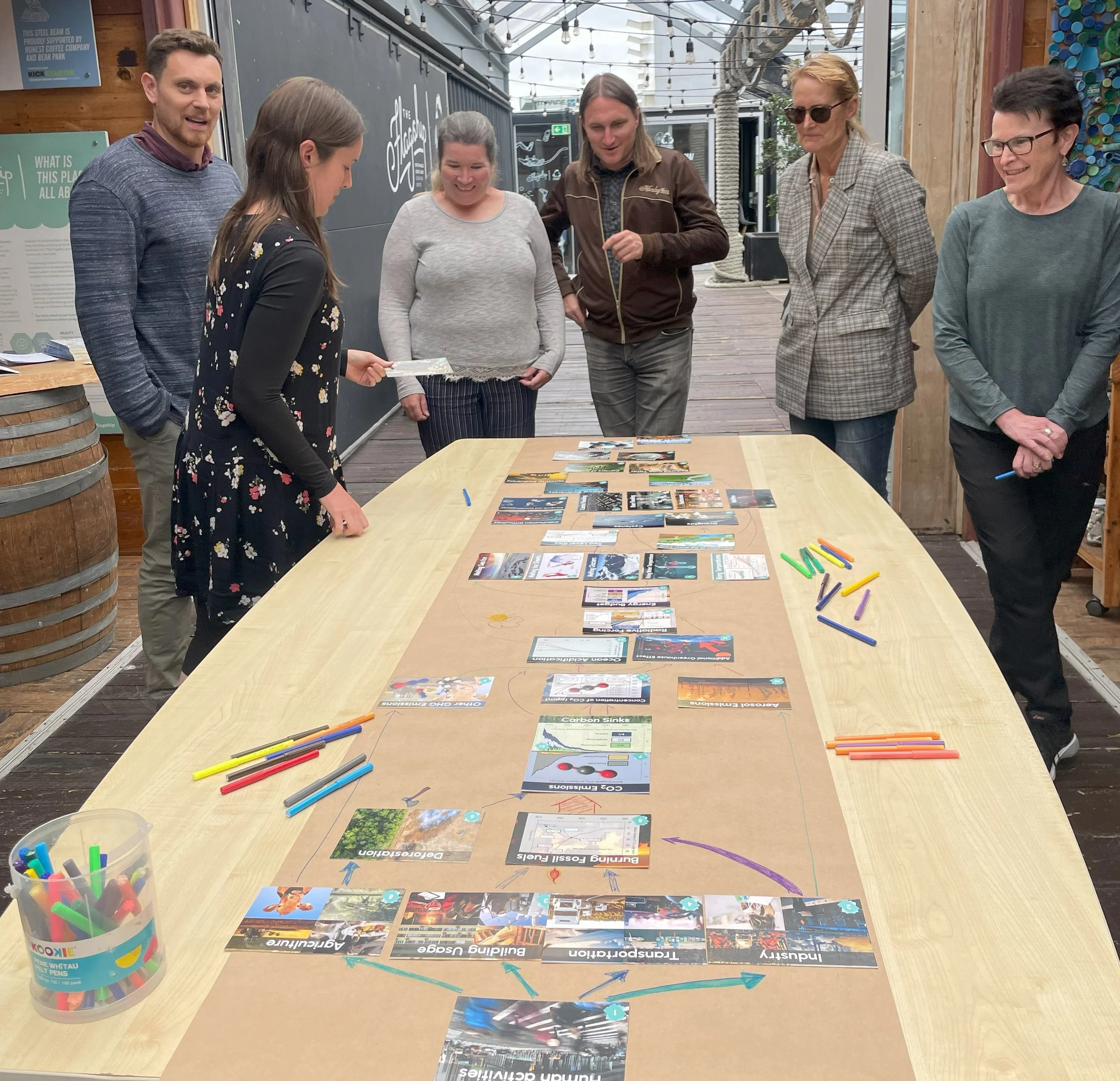
Climate Fresk is one of our favourite climate workshops. It runs for three hours. In groups, participants work through 42 cards to piece together how the climate system fits together. It summarises the science from the Intergovernmental Panel on Climate Change (IPCC) reports, which run to around 6,000 pages. Climate Fresk was designed in 2018 to make that science easier to get your head around. Its format is highly interactive and game-like. You build the picture yourselves, then talk about what it means for your organisation.
Getting everyone on the same page is what leaders tell us they value most. Briar Gill-Michaels, Principal Advisor Environmental Sustainability (Culture & Capability) at Maritime New Zealand, put it this way:
“There’s no other tool out there that gives executives an overview of how climate change works and a practical sense of urgency around taking action, so effectively, in such a short time, all in a fun, engaging game format.”
David Benattar, Chief Sustainability Officer at The Warehouse Group, described the Fresk as “one of the most effective programs we used to build a common understanding of the physical impact of climate change”, and added that it’s “approachable, playful, and sobering all at once.”
A workshop gives you the big picture and a shared language. It won’t make anyone a disclosure specialist or a qualified climate governance director. It’s the start of the conversation, not the whole education.
Side by side
| Feature | Climate course | Climate workshop |
|---|---|---|
| Time | Roughly 12 to 30 hours, spread over weeks | Three hours, one session |
| Format | Self-paced or online modules, done individually | Facilitated, in a group, hands-on |
| Best for | Building depth in one person | Getting a whole team on the same page |
| You end up with | Detailed knowledge and often a certificate | A shared understanding and ideas for action |
| Watch out for | Different people finish with different pictures | Not a substitute for specialist training |
So which one should you pick?
A few common situations:
Your leadership team needs a shared starting point for a strategy day. Go for a workshop. Michal Garvey, CEO of Foodprint, described theirs as “a great blend of education, inspiration and team building”, and recommended it for “any team, no matter what stage of the climate change journey you’re on.”
You want the whole organisation, or several teams, on the same footing. A workshop is much easier to roll out than asking everyone to complete a course.
One person is carrying your climate reporting work. A course will give them the detail they need.
Your directors need formal governance training. Look at a course built for that, like the IoD’s.
For a lot of organisations the answer is both. Run a workshop first so everyone understands why the work matters. Then send the people who will lead the organisation's climate actions on a course to build the depth. Doing the workshop first is helpful because it builds motivation - people tend to learn faster once they can see why it matters to them.
A few questions to ask before you book climate training
Will the people who make decisions be learning together, or separately?
How much time can your team spare, and when?
What do you want people to do differently afterwards?
Who is running it, and do they know your sector?
Thinking about a climate workshop?
We run Climate Fresk workshops for businesses, councils and community organisations in Tāmaki Makaurau Auckland, Te Whanganui-a-Tara Wellington and around the country. Many of our clients use them for leadership strategy days, staff sessions or team offsites. Every corporate workshop also helps fund community climate education, with 20% of profits going to grassroots climate action.
If you’d like to talk through what would suit your team, get in touch.